Showing posts with label book review. Show all posts

Sunday, July 20, 2014

Book Review: The Real Food Revival by Sherri Brooks Vinton and Ann Clark Espuelas

Click to buy. This is an affiliate link

The Real Food Revival by Sherri Brooks Vinton and Ann Clark Espuelas

This is a really excellent book.  You absolutely should get your hands on a copy right away. 

I picked this up at my first trip to the local library in my new city.  I got a lot of books on that particular trip, but this one really stood out.  While I just sort of flipped through the others for ideas, this one demanded that I sit down and read it cover-to-cover, which I did.  I even read portions of it aloud to David, who was curious what was capturing my attention so much (he then asked that I stop reading to him, because it was making him hungry). 

The Real Food Revival is a plea, from one food-lover to another, to make better eating choices.  It's very much in line with Michael Pollan's books; if you've read In Defense of Food (and you should), then the premise of this book should be pretty familiar.  Pollan is referenced a few times, and they share sources -- but this is more than a rehashing of Pollan's work. 

After a brief introduction to let you know what to expect, the book is broken off into sections, each one correlating to an aisle in the grocery store -- produce, meat, grains, etc.  Every chapter is organized in the same way: An introduction about the type of food, an "industrial agriculture snapshot" showing how those foods make their way to your table in the conventional system, and then tips for reviving real food -- such as ways to find organic produce, where to get grass-fed meat, etc. etc.  After that is a section highlighting a specific producer in-depth so that you can see how real people are working to combat the problems described early in the chapter. 

Interspersed among these sections are simple recipes that relate to the food being discussed, including a really delicious feta pie for the "ugly tomatoes" you end up with when you buy heirloom varieties.  Seriously, try that recipe, it's delicious. 

Moving on.  I really enjoyed this book.  It was packed with information, some of which I knew and some I really didn't (the entire section about seafood was mind-blowing for me), and the overall attitude of the book is very "can do" without speaking down to people or making them feel guilty for their choices.  The book's overarching message is very much in line with what I believe here at Lean Times -- someone might not be able to do everything, but everybody can do something to help make the world more sustainable. 

Have you read this book?  Share your opinion in the comments!  Also, I'm open to suggestions for what to read or watch next!

Wednesday, June 11, 2014

Book Review: The Urban Homestead by Kelly Coyne and Erik Knutzen

Click to buy.  This is an affiliate link. 
The Urban Homestead: Your Guide to Self-Sufficient Living in the Heart of the City by Kelly Coyne and Erik Knutzen

I picked up this book on a recent library journey.  Of the stack of books I brought home, this was definitely one of my favorites.  It appealed to me both because it's packed with useful information, but also because the voice is a little bit different -- kind of hip, sort of edgy, and missing that self-congratulatory goody-two-shoes tone that often creeps into some of these books.

Of course, "urban homesteading" has its own connotations that differ from other types of frugality or self-sufficiency.  The thing that appeals to me most about urban homesteading is that it's sort of a rebellious act.  Urban homesteaders want it all: We want to embrace the arts of our forefathers without giving up the things we love about the city.  Urban homesteading is all about developing self-sufficiency skills while staying connected to the world, and this book very much touches on that.

The Urban Homestead is an overview or entry-level guide.  It covers a broad spectrum of topics but doesn't go into great detail for any one of them.  You'll need to find another source for really in-depth information, and I wouldn't recommend running out to start any project in here based on the information within these pages alone.  But as far as a guide that introduces you to the realm of "what's possible," this is one of the very best I've read.

A few of the things it talks about:
  • Gardening
  • Composting
  • Foraging
  • Growing livestock 
  • Canning/preserving
It has two authors, and though they generally present a unified narration throughout the book, they're not afraid to give opposing views when a second voice is warranted.  Another feature that I really enjoyed is that they bring in other people's life experiences, with anecdotes scattered throughout.  That adds a lot of voices and different perspectives.


Anyway, if you're looking for something lighthearted, inspiring, a little geeky, a touch irreverent and very much full of ideas, this is definitely a book worth looking into.  If you're already living a sustainable lifestyle or are looking for more advanced suggestions, this probably won't cover any new ground for you -- but you may still enjoy reading it just for the tone and personality.  I give it two thumbs up for sure. 

Monday, May 19, 2014

Book Review: Not Buying It by Judith Levine

Click to buy.  This is an affiliate link
Not Buying It: My Year Without Shopping
by Judith Levine

This was one of the more enjoyable books I picked up at a recent library venture.  This is not a practical guide by any means.  It's a memoir, heavily introspective and tied up in politics, and it's fascinating from an anthropological standpoint even if you reject many of the "messages" of the book.

The gist of it is simple: Fed up with Christmas shopping, Judith Levine and her long-term partner Paul decide to embark on a quest of one year buying only the necessities.  She documents this quest in a sort of diary format, with each chapter representing one month.

What made this book particularly fascinating for me is that it takes place between 2003-2004, and is heavily enmeshed in the politics of that era.  Reading it today is a bit like conversing with a Dickensian ghost of the past.  Since so many anti-consumerist, pro-frugality books are reactive, existing in response to the recession, it was refreshing (albeit depressing) to see someone preaching that philosophy at a time when, culturally, we were by and large still convinced of the power of excess.

The writing itself I found to be engaging, although it's certainly not to everyone's tastes as evidenced by the not-very-charitable reviews on Amazon.  The "character" of our narrator/author is in turns fascinating and aggravating.  She's naive and snobby, but no moreso than any other New Yorker (sorry, guys), and she's making a genuine effort.  Although we share a common career, our lives and experiences couldn't be any different...which was, ultimately, the key to much of my enjoyment of this book.

Anyway, it's worth the read, but don't expect to pick up any valuable information from it.  This is not a how-to guide, and it's painfully bourgeois for anyone who is actually getting through life on a budget. 

Friday, November 22, 2013

Review: Freakonomics

http://www.amazon.com/gp/product/0060731338/ref=as_li_qf_sp_asin_il_tl?ie=UTF8&camp=1789&creative=9325&creativeASIN=0060731338&linkCode=as2&tag=tlbo04-20
Click to buy. This is an affiliate link
Freakonomics: A Rogue Economist Explores the Hidden Side of Everything by Steven D. Levitt and Stephen J. Dubner

This is a really excellent book. 

I'm not sure why it's taken me so long to get around to reading it.  It was recommended to me some time ago by my brother, who knows precisely what type of books will appeal to me, and he was right: I devoured this book in two sittings and eagerly wished for more.  I understand that there's a documentary version of it that's also quite good. 

Anyway: Freakonomics isn't a how-to, precisely, nor does it deal with any particular economic problem.  Instead, it's roughly divided into a few essays that seek to find the relationship between apparently unrelated things: it talks about cheating among sumo wrestlers and teachers; it discusses the role abortion plays in crime; it questions whether parents really play an important role in the outcome of their offspring and whether names make a difference in your success.  It does all of this in an engaging writing style filled with anecdotes, a style that easily breaks down complicated concepts.  

What makes this book great isn't its conclusions (which are themselves quite insightful) but the fact that it shows you how those conclusions are made.  It teaches you how to think critically, which is a skill sorely lacking among many people.  It also adds a humanizing side to economics, which can seem horribly abstract and dull. 

If I were to design a home-school curriculum, I would include this book as a supplemental text -- that's how good it is.  (I often think of home-schooling my future children.  As a home-schooled kid myself, it seems only natural). I recommend this book to everyone. 

Tuesday, November 19, 2013

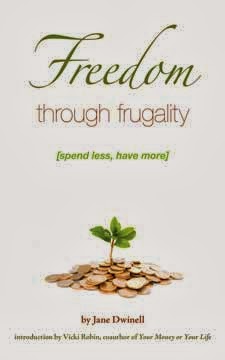
Book Review: Freedom Through Frugality

http://www.amazon.com/gp/product/0979912520/ref=as_li_qf_sp_asin_il_tl?ie=UTF8&camp=1789&creative=9325&creativeASIN=0979912520&linkCode=as2&tag=tlbo04-20
Click to buy.  This is an affiliate link.
Freedom Through Frugality: Spend Less, Have More
by Jane Dwinell

To be honest, I wasn't entirely sure that I was going to like this book when I started reading it.  The first few chapters, where the author extolls the benefits of frugality and establishes her credibility, had me rolling my eyes quite a bit.  Like many authors in this niche, Dwinell tries too hard to to establish herself as an expert, and the result comes off as a little sanctimonious.  You know those people on Pinterest who seem to have perfect lives, and how you want to punch them?  It's kind of like that.

I'm glad I stuck with it, though, because the rest of the book is jam-packed with useful, pragmatic tips.  Many of them are pretty basic or things I already knew, but I did get a few decent ideas, and I came to like the author more by the end of it -- once I realized that we perhaps have more in common than I'd thought.

The audience for this book is obviously the overworked middle class (isn't that the audience of all of these books?), and she does pander to them a bit, but she also sticks to her principles, and I respect that.  The basic message of the book is that frugality allows you to have more freedom -- by having fewer material possessions and needs, you can cut down on how much time you need to work and spend your time pursuing your passions instead.  That's certainly a message I can get behind.  She also looks at frugality not as a means to an end but as a philosophy -- being frugal isn't about having few things, it's about really appreciating the things you have and being thoughtful in each decision you make.

This is worth reading.  If you're pretty new to budgeting and need some practical tips, this is a good place to start.  The ideas stay fairly vague, so this is more of an entry-level book than a blackbelt's guide, but I'd still recommend it.